

7 Attributes of a Happy Peace-Filled Home (Part 2)

Today’s post is part 2 in the series 7 Attributes of a Happy Peace-Filled Home. Part 1 of the series begins with a story from when our son, Jordan, was 10 or 11. It sets the tone for this three-part series. If you haven’t read that first, you can read it here 7 Attributes of a Happy & Peace-Filled Home (Part 1).

Let’s Review Attributes of A Happy & Peace-filled Home (Part 1)
In part 1, you will find the first three attributes of the 7 Attributes of a Happy Peace-Filled Home. Let’s review them first. The first attribute of a happy peace-filled home is that it has LOVE~ love of God, love of others, and love of themselves

The second attribute of a happy peace-filled home is RESPECT. You will discover the importance of respect as a foundation and several ways to introduce and teach respect to your children.
The third attribute of a happy peace-filled home is BOUNDARIES. Boundaries are created rules and routines in your home. I discussed the importance of establishing boundaries and how it is extremely important in laying the foundation for a happy peace-filled home.
We learned that unclear rules and sporadic reinforcement breed insecurity in children and we looked at the consequences of that. I directed you to a post called How to Set The Foundation for a Loving Home which will also help with building a strong foundation in your home that will also lead to a happy peace-filled home.
And that leads us to number four in the 7 Attributes of a Happy Peace-filled Home, DISCIPLINE.
A Happy Peace-Filled Home has Discipline
The previous post in the series (Part 1) ended with the attribute of boundaries. BUT, what happens when boundaries are crossed and rules are broken? Where do you go from there?
Be Consistent
Remember the statement from above about sporadic reinforcement and what it breeds? We learned that it breeds insecurity. As a parent, we don’t want our children to ever feel insecure. So what do we do? We have to make sure we reinforce the boundaries.

Reinforcement of boundaries must be consistent and not sporadic. I want to reemphasize this… CONSISTENCY IS KEY. It is so important to help our children feel safe and secure and loved at all times. Let’s talk about how to do that and the topic of discipline.
Discipline is the practice of training children to obey rules or a code of behavior, using punishment to correct disobedience.
The word “discipline” can have a negative connotation to it, but read that definition again. Go ahead! Read it again!
Discipline in childhood helps children avoid “learning the hard way” later in life. As parents, it is important that you set boundaries, guidelines, rules, and clear expectations in your home.
Give Grace
Disciplining with consequences when boundaries are crossed or rules are broken is very important in order to maintain a happy peace-filled home. See more below but first let’s talk about the topic of grace.
When disciplining, it is important to give grace at times. God’s grace is abundant when we mess up. There are instances when we extend grace to our children to show them the love of God. But what happens when their behavior becomes what they are characterized by? It is definitely time for consequences to be employed. Discipline with consequences is imperative for training your child.
Always Discipline with Love
So what does disciplining with love look like? Many times when boundaries are crossed or rules are broken, we are upset and can act rashly. First of all, I want to encourage you that when you discipline ALWAYS do it calmly and with love.
Never Discipline While Angry
Maintain your cool. So take a minute, take a deep breath, say a prayer, and ask God to guide and lead you and give you wisdom. Consequences should always be out of love, not anger. If you need to count to ten or leave the room for a few minutes then do it. Get your composure, process your thoughts, and then proceed.
Take Your Time
Always take your time. Don’t rush to punishment until you’ve thought about it thoroughly. If I needed time and someone to bounce ideas off of, I would let them know that I would discuss it with Dad when he get home.
Sometimes waiting for the punishment is hard but also allows them time to really regret what they have done. Fear of the unknown can have a powerful impact 😘.

Don’t throw out a rash punishment such as “you are going to be in your room for a month”. A punishment like that, more than likely, won’t be something you can follow through with.
Be wise in your choice of punishment. After all, you don’t want it to punish you more than your child.
If age-appropriate, have a conversation about what happened. Explain the reason why you must give a punishment. It is important to let them know you are disciplining out of love not anger.
Reconciliation
Always follow up with reconciliation. Be sure to follow up with hugs and I love you and offer forgiveness for a genuine apology. And remember, forgiveness does not mean you take away the consequence and CONSISTENCY IS KEY!
Consequences
We have finally arrived at the topic of consequences. It’s so important to teach your child discipline, but what happens when the line is crossed on the boundaries you have set? Let’s look at consequences as the next step in the discipline process.
Some forms of discipline may involve things like time out, loss of privileges, earlier bedtimes, less play time, loss of technology including IPads, phones, video games, tv time, loss of friend time, etc.
Let’s break down the consequences into natural consequences and created consequences.
Natural Consequences
What do I mean by a natural consequence? The natural consequence may be a sufficient punishment in some circumstances. A natural consequence, for example, might be if they continue to stick their fingers in the outlets they get shocked (one of our sons loved putting his fingers in the outlets).
Pain is definitely a natural consequence. Not that we want them to suffer natural consequences, especially if they get hurt but sometimes it is the best teacher.
Let me share an example from our own family. When our son Jacob was 13, he decided he wanted his hair to be more blonde. He proceeded to find his way to a store, buy hair dye and have one of his friends dye it for him. He did this behind our backs and without permission.

In today’s world, this might be a little more acceptable given it is apparently cool to add color to your hair but this wasn’t the case in 2005.
The intended color was blonde but what resulted was a pretty bad color of maroon 🤪. He was mortified and, of course, apologetic and begged me to call my friend who was a hairstylist, and “fix this” right away. Did I mention this was one day before my mother-in-law arrived for a visit? 🤦🏼♀️
My husband and I discussed it and decided he would learn a lesson if we let him keep the hair for a few days and live with the results. So THIS was a natural consequence of his decision.
It is such a blessing to see our son now as an adult. See the picture below from November 2022 getting engaged. Enacting consequences or allowing your child to suffer natural consequences may prevent them from making an unwise decision in his or her future.

Created Consequences
But what happens when there are no natural consequences? This is when it is time to impose created consequences. Let’s look at what those might be.
What if you have a rule that when dinner is finished every child must take their plate to the sink and they continually forget or choose not to do it? In that circumstance, perhaps you might have them clear the whole table for the next couple of dinners. This would definitely reinforce the rule.
What if they continually slam the door in anger when something doesn’t go their way? Perhaps you might remove the door to their bedroom for a few days and have them feel what it is like to not have a door. Teach them that having a door in their room is a privilege and this behavior could cause them to lose that privilege..
What if one of your children is continually mean to one of their siblings? You could have them serve that sibling in some way. Have them make their bed or put away their laundry. I bet this would cause them to consider their actions in the future.
Parenting takes creativity at times. Get creative! Consequences and ensuing punishment will reinforce that you mean business when you make a rule.

Corporal Discipline
Many parents ask me about spanking. The book of Proverbs refers to using the rod in a few verses. Proverbs 29:15 says, “A rod and a reprimand impart wisdom, but a child left undisciplined disgraces its mother.”
I believe corporal discipline is a decision each parent needs to make for themselves. I do not think it is wrong. However, I do believe that using “a rod” apart from biblical principles, can cause more harm than good.
Corporal discipline should only be used with love and out of the best interest of the child. I suggest an object and not a hand. And always, ALWAYS, make sure reconciliation happens ending with hugs and loving words.
We did spank, but it was only when all else failed. To be honest, it was only utilized when nothing else worked and under the guidelines given above.
Personal Disciplines
Discipline also involves teaching them to be disciplined in their own personal life and daily habits. Let’s look at some of those below:
- Brushing their teeth
- Taking a bath
- Putting their clothes in the hamper
- Making their bed
- Picking up their toys
- Clearing their plate from the table
- And whatever you deem to be a personal discipline
But more importantly, teaching AND modeling for them the disciplines above as well as spiritual disciplines such as reading their bible and praying. This can be taught AND caught at a very early age.
- Reading a children’s bible on a regular basis
- Singing and listening to Bible songs or worship songs
- Praying at meals and at bedtime or when you see an immediate need
Doing these acts of personal discipline on the regular will help your child establish patterns of discipline in their life.
As you have just read, there are quite a few aspects of discipline. It is a vital attribute in the 7 Attributes of a Happy Peace-filled Home.
And now we move on to number five in the list of attributes ~ FORGIVENESS.

A Happy Peace-Filled Home has Forgiveness
As I stated above, always make sure there is forgiveness at the end of a situation that requires discipline and consequences. This brings us to the fifth attribute in the series, FORGIVENESS.
Teach your child to say I’m sorry but just as important, teach them to forgive when apologized to. Teach them to say “I’m sorry” AND “I forgive you”. Forgiveness is a very important lesson for your children to learn both in forgiving and asking for forgiveness.
Remind your child that they are sinners and that God forgives them every day. Also, share with them God’s word and what he says about forgiveness. See the verses listed below:

When we sin against God it is important for us to ask Him for forgiveness. So teach them to ask for forgiveness from God as well as the person they have wronged.
It might even suggest taking a moment to pray with them. Your child can pray themselves or you can pray for them depending on their age. This is a good habit to reinforce in your child’s heart.
Instilling in your children the ability to say I’m sorry is immensely important to an impressionable young child and will serve them well for a lifetime.
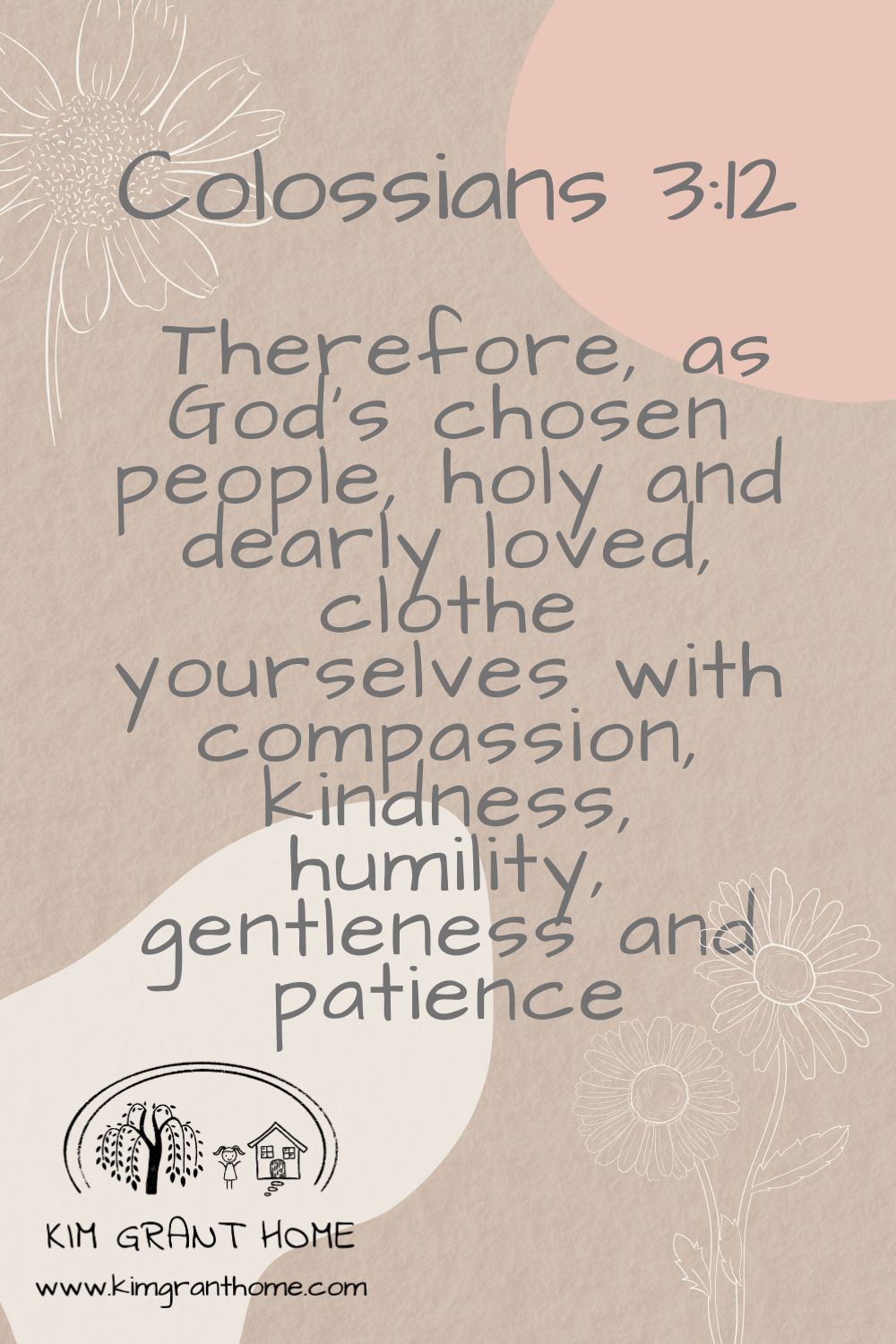
Saying I’m sorry is an act of humility and says a lot about who a person is deep within their heart. How many of you know someone who really struggles to admit when they are wrong? This is an unattractive quality in an adult. Humility is a much more attractive quality.

As parents, it is important for us to model humility and ask for forgiveness. Admitting when you are wrong goes a long way in building relationships and keeping lines of communication open between you and your children. I’ve had to apologize to my children many times in my parenting years.
Somehow by God’s grace, my kids are all very generous when it comes to accepting my apologies. I am so grateful for this and blessed by it. I believe that teaching them the principle of forgiveness has served them well in their adulthood.
So there you have it! Two more attributes in our series of 7 Attributes of a Happy & Peace-filled Home. Let’s review.
- Love
- Respect
- Boundaries
- Discipline
- Forgiveness
You can link to the final two attributes 7 Attributes of a Happy & Peace-filled Home (Part 3) here. I am so excited for you as you seek to grow in the area of creating a happy and peace-filled home.
It is not easy and it is definitely a lot of hard work including disappointments and tears along the way. But isn’t it sweet when you see success and a taste of victory in what you are trying to do?
Remember to be consistent and diligent and remember it will be worth every minute. I believe in you! I believe you can do it. You are in this for the long haul. You are in it for your family and the life you see in the future with your children. Keep it up, mama! You’ve got this!
Much Love~Kim💗
Remember to check out these noted posts:
7 Attributes of a Happy & Peace-Filled Home (Part 1)


